
What is MITA?
MITA = Minimally Invasive Distal Transverse Metatarsal Osteotomy–Akin Osteotomy
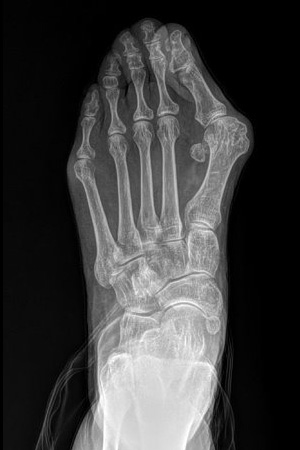
MITA stands for Minimally Invasive Distal Transverse Metatarsal Osteotomy with an Akin osteotomy — a percutaneous technique to correct a bunion (hallux valgus).
Through a few 3–5 mm skin incisions, the surgeon uses a fine, specialized bone burr under real-time X-ray (fluoroscopic) guidance to make a transverse cut at the neck of the first metatarsal. The bone is then shifted into a corrected position and held with one or two small screws. A second tiny cut at the base of the big toe (the Akin osteotomy) fine-tunes the alignment. Because the correction is done outside the joint and through minimal incisions, soft tissues are preserved and recovery is typically faster than with traditional open surgery.
A growing body of evidence supports MITA/MIS bunion correction as non-inferior to open surgery, with comparable deformity correction and quicker early recovery. In a recent large series of 493 cases (2025), the hallux valgus angle improved on average from 34° to 8° and the intermetatarsal angle from 13° to 6°.
Why minimally invasive surgery?
Reliable results in well-selected patients — including older adults.
Smaller incisions — a few millimeters rather than a long medial incision, meaning less soft-tissue disruption.
Faster early recovery — most patients bear weight immediately in a stiff-soled surgical sandal.
Powerful correction — the percutaneous osteotomy can address mild to severe deformity (not only small bunions).
What to expect after surgery
Recovery after MITA is designed to get you moving comfortably and safely. For the first two weeks, the foot is protected in a half-cast (splint). From about two to four weeks, you transition into a postoperative shoe for weight-bearing. From six weeks onward, most patients can walk freely in regular footwear, while continuing to use a toe spacer to help maintain the corrected alignment of the big toe.
At around four months, if any implant creates a sense of hardware irritation, the screws can be removed at your request to eliminate that discomfort. Recovery timelines vary from person to person, and your progress will be reviewed at each visit.
Related reading: MIS 1st MTP Fusion (First MTP Joint Arthrodesis)
Leave a Reply